
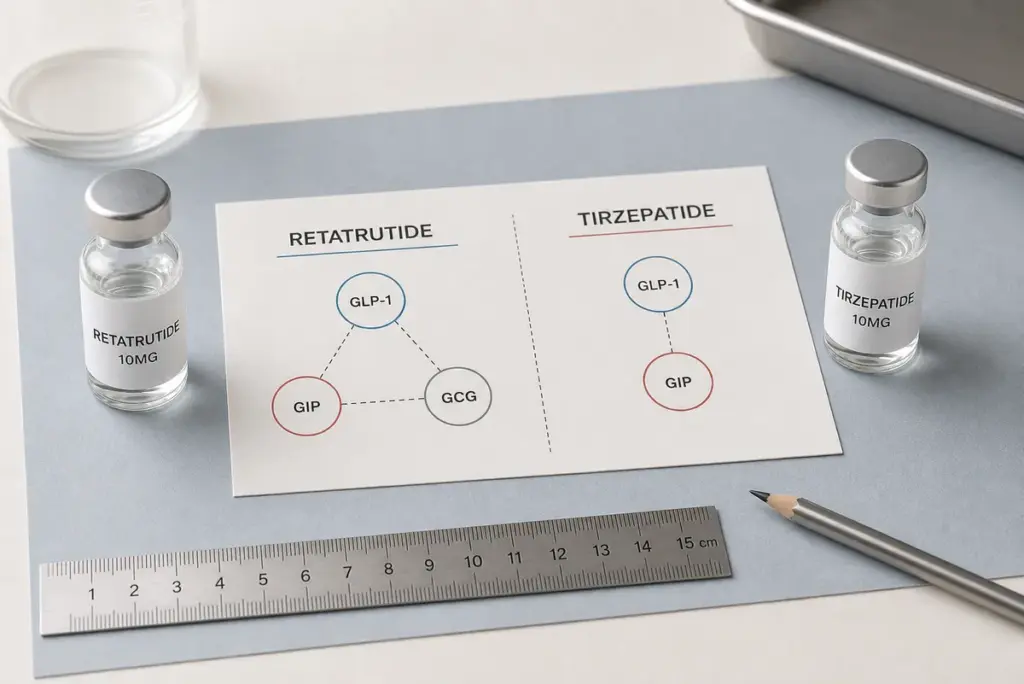
Retatrutide and Tirzepatide get filed together as 'next-generation' incretin-mimetic research peptides, and the label hides how far apart they sit. Tirzepatide engages two receptors: the GLP-1 receptor and the GIP receptor. Retatrutide engages three: GLP-1, GIP, and the glucagon receptor (GCGR). Adding the glucagon arm is not a larger dose of the same idea. It changes the class of metabolic question the molecule can be used to study.
Both came out of the same drug-discovery lineage, which is part of why the comparison comes up so often. The receptor count is where the comparison ends, because two receptors and three receptors do not produce the same downstream signature. The extra arm rewires the response rather than turning it up.
Tirzepatide: the dual-agonist reference
Tirzepatide adds GIP-receptor activation to a GLP-1 baseline. GIP is the other major incretin hormone released after a meal, and pairing it with GLP-1 in a single molecule was the design goal. The 2018 Molecular Metabolism paper that introduced the compound characterized it as a single peptide activating both receptors, and reported larger reductions in glucose and body weight in research models than selective GLP-1 agonism produced on its own.
The practical effect of the GIP arm is that it amplifies the satiety signal and steepens the glycemic-response curve without amplifying GI-pathway side-effect signaling in the same proportion. That balance is why most current metabolic-research protocols treat Tirzepatide as the dual-agonist standard. A single-pathway GLP-1 compound isolates one mechanism; Tirzepatide is the cleaner instrument for studying how two incretin pathways interact.
Its footprint reaches past glucose and weight. In a 2020 Diabetes Care study, tirzepatide lowered biomarkers linked to non-alcoholic steatohepatitis and raised adiponectin in type 2 diabetes research subjects. That breadth is the kind of result the dual-receptor design predicts, and it is part of why the compound is studied well beyond glycemic endpoints.
Retatrutide: adding the glucagon axis
Retatrutide adds glucagon-receptor (GCGR) activation on top of GLP-1 and GIP. The 2022 Cell Metabolism paper that introduced it reported that, in obese-mouse models, the glucagon-receptor arm drove increased energy expenditure while the GIP and GLP-1 arms reduced caloric intake. The glucagon axis is what pulls hepatic energy metabolism and lipolysis into the response.
On its own, glucagon-receptor agonism would push glucose up, which is the opposite of what a metabolic compound usually wants. The engineering sits in the receptor balance. Combined with the GLP-1 and GIP arms, the net effect in research models is improved glucose handling alongside higher energy expenditure. The triple agonist is not three drugs sharing a vial; it is one molecule whose receptor ratio was deliberately tuned during design.
What the receptor gap means for a research design
A protocol built around glycemic-response kinetics and appetite-pathway interaction is best served by Tirzepatide. The dual-agonist envelope is the cleanest instrument for that question. A protocol built around hepatic glucose output, energy-expenditure modeling, or lipid handling points to Retatrutide as the triple-agonist tool.
The error is treating the two as interchangeable potencies of one compound. They are different instruments. Mismatching the compound to the question adds noise, not signal. The receptor profile is the experimental variable, and the molecule is just the way that variable gets delivered.
Running them side by side is a design in its own right. Holding everything else constant and comparing dual against triple engagement is how a study isolates what the glucagon arm actually contributes, which is difficult to read from either compound studied alone.
Operational notes
Both compounds ship lyophilized in 10mg vials, reconstitute in standard bacteriostatic water for injection, and store at −20°C in the lyophilized state. Janoshik third-party HPLC verification applies to each per-lot.
For designs that compare dual- and triple-agonist responses head to head, the lot-matching guidance is the same as any cross-compound study. Pair lots from the same synthesis window and read the COA for each side independently, so lot-to-lot variance does not get mistaken for a mechanism difference.
This article describes mechanisms and applications studied in research models. NZM peptides are sold strictly for in vitro and animal research. They are not for human consumption, off-label use, or clinical application.
From the desk.

Wegovy vs Ozempic: Same Compound, Different Brand Identity
Wegovy and Ozempic share the same active molecule (semaglutide). They are distinct branded products with different indications and dose strengths, but the mechanism is…

Solid-Phase Peptide Synthesis: How Research-Grade Peptides Are Actually Made
Solid-phase peptide synthesis is the chemistry behind every research peptide in the modern catalog: how the process works, why it governs purity, and how…
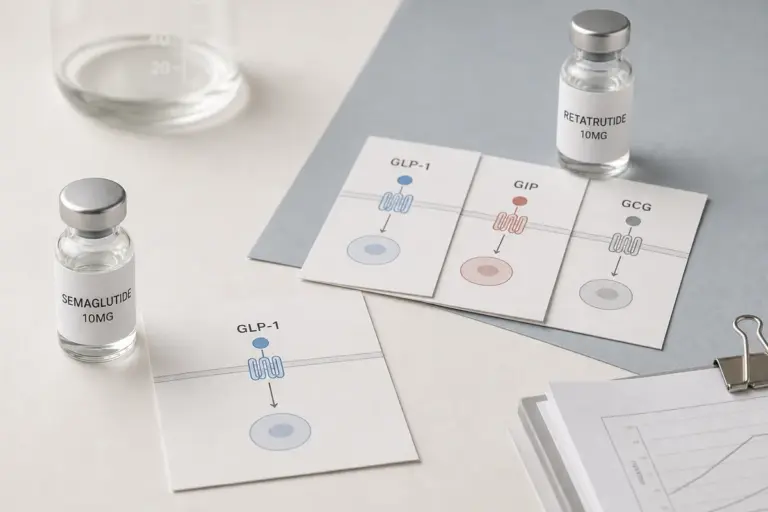
Retatrutide vs Semaglutide: Triple-Agonist vs Single-Pathway GLP-1
Semaglutide engages one receptor; Retatrutide engages three. The mechanism gap is wider than the family relationship suggests, and it changes what each compound is…