
Reconstitution 101: How to Properly Prepare Lyophilized Peptides for Research
A practical lab-handling guide to reconstituting research-grade lyophilized peptides: choice of solvent, technique, post-reconstitution stability, and the operational mistakes that ruin protocol consistency.
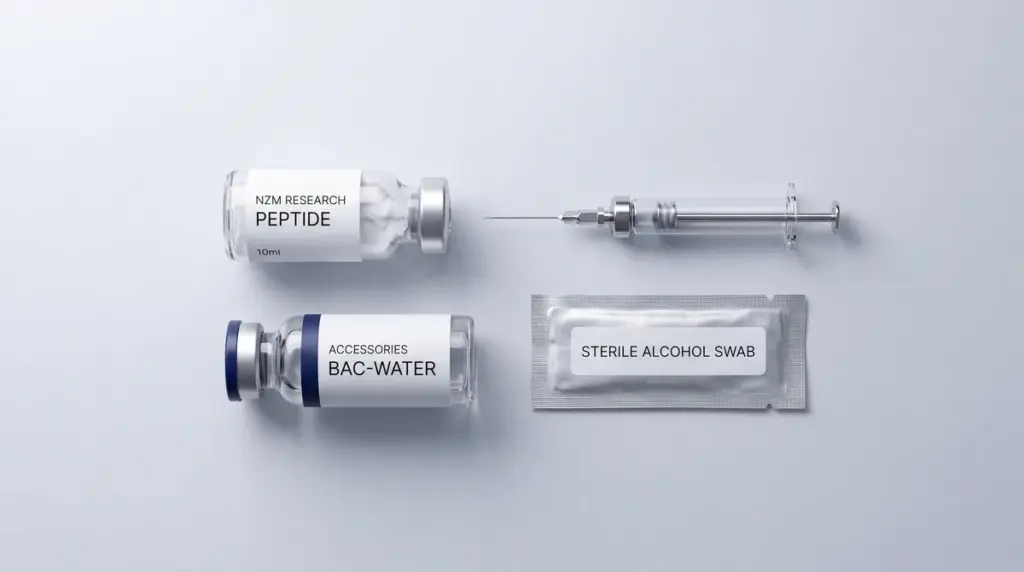
Reconstitution is the single most overlooked source of variance in research-peptide protocols. Not because it is difficult, because it is not, but because the discipline that produces consistent reconstitution is rarely written down. Most protocol drift starts right here, at the bench, before the experiment proper has begun.
This is a lab-handling guide for researchers preparing lyophilized peptides for in-vitro or research-model work. It assumes a research context throughout. Nothing here applies to clinical or human application, which is outside our scope and our policy.
Solvent: bacteriostatic water, not sterile water
Bacteriostatic water for injection is plain water with one addition: roughly 0.9% benzyl alcohol, which acts as an antimicrobial preservative. The FDA labeling spells out that composition. The benzyl alcohol is what lets a reconstituted vial hold up for two to four weeks under refrigeration instead of being a single-session preparation.
Plain sterile water, with no preservative, is usable, but only for a same-session protocol where the entire reconstituted vial is used in one window. For any multi-day or multi-week research design, bacteriostatic water is the operationally correct solvent. Switching solvents between studies quietly introduces a variable that has nothing to do with the hypothesis.
Technique: slow flow against the wall
Withdraw the calculated solvent volume into a sterile syringe. Insert the needle through the vial septum at an angle and let the solvent run slowly down the inner wall of the vial, not straight onto the lyophilized pellet. Direct hydraulic impact on the pellet shears peptide molecules and costs measurable potency.
Once the solvent is in, do not shake. Roll the vial gently between your palms or invert it slowly until the powder dissolves, which usually takes under a minute. If the solution stays cloudy, the vial has either been compromised or the contents are not what the label claims. Either way, that is a stop signal, not something to push past.
Concentration math: calculate before you reconstitute
Reconstitution volume sets the per-unit concentration, so the math comes before the needle. A 10mg lyophilized vial reconstituted in 2mL yields 5mg/mL; the same vial in 5mL yields 2mg/mL. Which one is right depends on the per-aliquot volume the protocol design calls for.
Smaller volumes give higher concentrations and finer per-aliquot precision, at the cost of fewer total aliquots per vial. The right choice is whichever makes per-aliquot measurement most accurate within the protocol’s tolerance. Deciding that after reconstitution is deciding it too late.
Storage: keep the solid state stable
Peptides are more stable as a dry solid than in solution, which is why they ship lyophilized. A 2021 review in Advanced Drug Delivery Reviews notes that biomolecules are generally less stable in the liquid state than the solid state, and that freezing introduces its own destabilizing stresses, including cold denaturation and concentration effects as the solution freezes. A 2024 review in Pharmaceutics covers how lyophilization converts a protein solution into a stable dry form, and why the drying process itself has to be handled carefully.
The practical takeaways follow from that. Reconstituted vials belong in a refrigerator at 2 to 8°C, not a freezer, and repeatedly freezing and thawing a reconstituted vial stresses the peptide and is best avoided. Lyophilized vials, by contrast, stay stable at −20°C for roughly 24 to 36 months depending on the compound. The lyophilized state is the storage state, and reconstitution is a one-way operation you run when the protocol is ready to use the material.
This article describes mechanisms and applications studied in research models. NZM peptides are sold strictly for in vitro and animal research. They are not for human consumption, off-label use, or clinical application.
From the desk.

Solid-Phase Peptide Synthesis: How Research-Grade Peptides Are Actually Made
Solid-phase peptide synthesis is the chemistry behind every research peptide in the modern catalog: how the process works, why it governs purity, and how to read a synthesis report on a COA.

Why Janoshik Analytical: A Researcher's Guide to Independent Lab Verification
Independent third-party verification is the only credible way to certify what's actually in a research-grade peptide vial. Here's why Janoshik is the European reference, and what their COA actually tells you.

BPC-157 vs TB-500: Single Compounds or the WOLVERINE Blend?
Two of the most-cited tissue-repair peptides cover complementary mechanisms. When does a research protocol benefit from each individually, and when does the WOLVERINE blend make sense?