
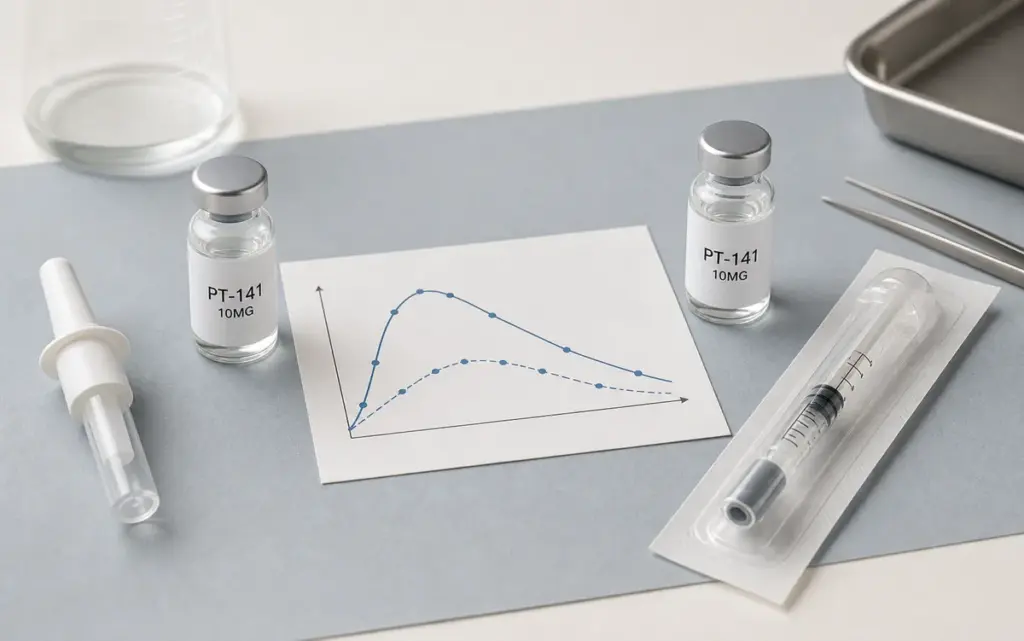
PT-141 (bremelanotide) is a melanocortin-receptor agonist with a research literature that spans two delivery routes: intranasal and subcutaneous injection. The two routes do not produce equivalent pharmacokinetics. The absorption profile, the timing of peak plasma concentration, and total bioavailability all differ between them.
For research designs studying melanocortin-receptor pharmacology, the route is a methodological variable, not a convenience. It changes what the resulting data can be said to mean, which is why it deserves to be chosen deliberately rather than defaulted.
What PT-141 is
Bremelanotide is a synthetic analog of alpha-melanocyte-stimulating hormone, and it acts as an agonist across several melanocortin receptors. A 2003 paper in the Annals of the New York Academy of Sciences describes it as a melanocortin agonist acting on receptors expressed largely in the central nervous system. The FDA label for the approved subcutaneous form, bremelanotide, notes that it binds several melanocortin subtypes, with MC1R and MC4R the most relevant at therapeutic exposures.
For the purposes of this article, the receptor most associated with the primary CNS-mediated research mechanism is MC4R. That receptor sits in the central nervous system, which is the reason route of administration is not a trivial detail. How the molecule reaches the CNS shapes the response.
Why route matters for melanocortin research
Melanocortin receptors are distributed across many tissues, and the central-nervous-system MC4R population is reached differently depending on how the molecule enters the body. A drug arriving through systemic circulation reaches CNS receptors by one path; a drug arriving through the nasal mucosa has another path partly available to it.
Intranasal delivery has a partial direct-to-CNS route through the olfactory mucosa, bypassing some of the systemic journey. Subcutaneous delivery routes the molecule through systemic circulation and across the blood-brain barrier. The two produce different distribution kinetics even when the same total amount is absorbed, which is the core reason route is an experimental variable rather than a packaging choice.
Intranasal: fast onset, lower total bioavailability
Intranasal PT-141 reaches peak plasma concentration faster than subcutaneous administration. A 2004 study in the International Journal of Impotence Research reported a median time-to-peak of about half an hour for the intranasal route, with an elimination half-life in the range of roughly two hours. The trade-off is total bioavailability: a fraction of an intranasal dose is lost to mucociliary clearance before it is absorbed.
That profile suits research designs built around acute, short-window kinetics, where the speed of onset is the variable of interest. Studies specifically probing the partial direct-to-CNS uptake pathway require the intranasal route, because that pathway does not exist for an injected dose.
Subcutaneous: predictable, slower
Subcutaneous PT-141 produces a slower but more reproducible plasma curve. The absorbed fraction is higher and varies less between sessions, which is why subcutaneous is the route the approved formulation uses, and the one that suits studies needing quantitative, repeatable exposure data.
For research into systemic melanocortin pharmacology, where the question is total receptor engagement across distributed tissue rather than speed of onset, the lower session-to-session variance of the subcutaneous route is the deciding advantage.
Operational notes
PT-141 ships lyophilized in 10mg vials and reconstitutes in standard bacteriostatic water for injection regardless of the intended research route. The compound is identical; only the post-reconstitution delivery method changes. Per-lot Janoshik HPLC verification applies either way, and a cross-route study comparing intranasal against subcutaneous response should pair lots from the same synthesis window so lot variance does not masquerade as a route effect.
This article describes mechanisms and applications studied in research models. NZM peptides are sold strictly for in vitro and animal research. They are not for human consumption, off-label use, or clinical application.
From the desk.
Wegovy vs Ozempic: Same Compound, Different Brand Identity
Wegovy and Ozempic share the same active molecule (semaglutide). They are distinct branded products with different indications and dose strengths, but the mechanism is…
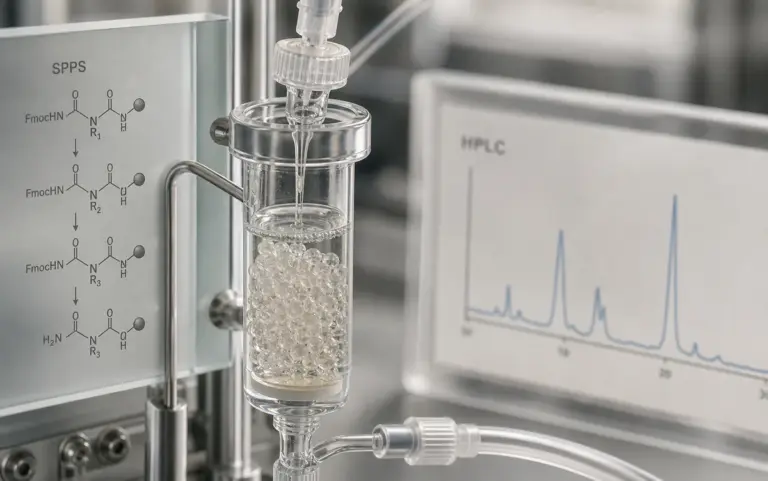
Solid-Phase Peptide Synthesis: How Research-Grade Peptides Are Actually Made
Solid-phase peptide synthesis is the chemistry behind every research peptide in the modern catalog: how the process works, why it governs purity, and how…
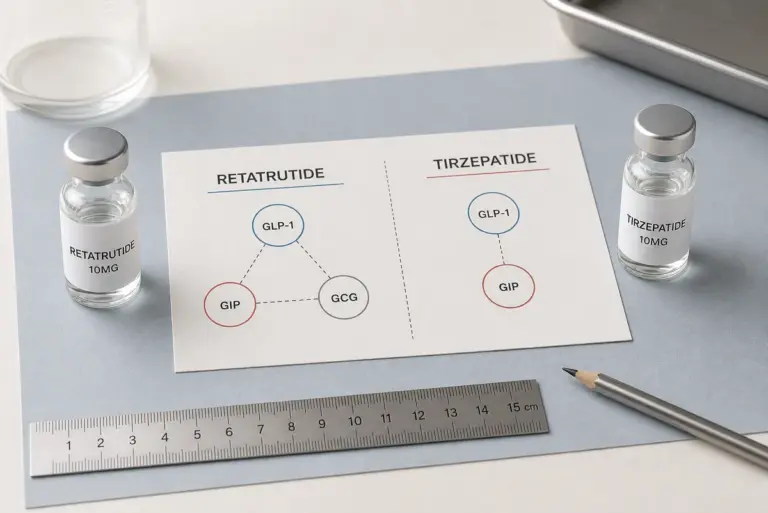
Retatrutide vs Tirzepatide: Triple-Agonist vs Dual-Agonist Mechanism
Both are incretin-mimetic research peptides, but they engage categorically different receptor combinations. The mechanism distinction is what determines which one suits a given protocol.