
Ipamorelin + CJC-1295: Paired GH-Secretagogue Mechanism in Research
Ipamorelin and CJC-1295 (no DAC) are the canonical GH-secretagogue research pairing. The pairing reflects complementary receptor pathways: ghrelin-receptor agonism plus GHRH-receptor agonism, not a single-mechanism stack.
Most published research protocols using growth-hormone secretagogues converge on the same pairing: Ipamorelin alongside CJC-1295 (no DAC). The pairing is neither novel nor contested. What is worth understanding is the mechanism reasoning behind it, which comes down to why two compounds rather than one, and why these two.
The two act on parallel but distinct pathways of the GH axis, and engaging both in the same protocol produces a different downstream signature than either produces alone. The difference is structural rather than merely additive.
Two receptors, one GH axis
Ipamorelin is a selective agonist at the ghrelin receptor (GHSR-1a), and its defining property is that selectivity. The 1998 European Journal of Endocrinology paper that first described it reported that it released growth hormone with potency comparable to earlier secretagogues but, unlike them, did not raise ACTH or cortisol above the levels seen with GHRH alone, and left prolactin, FSH, LH, and TSH untouched. A clean GH pulse without the endocrine collateral is the operating advantage.
CJC-1295 is a GHRH analog. It binds the GHRH receptor and amplifies the endogenous GHRH signal rather than producing a pulse from nothing. So Ipamorelin works the ghrelin pathway while CJC-1295 works the natural GHRH axis. The two are complementary by mechanism, hitting the GH axis from two directions at once. Tesamorelin is a longer-acting GHRH analog studied on the same receptor axis, and a useful comparison point when the question is about GHRH engagement specifically.
The pulse is the signal
Pulsatility matters because the body does not release growth hormone in a steady stream. It releases it in bursts, and the systems downstream of GH are tuned to that burst pattern. A compound that floods the receptor with a constant signal can raise measured GH while flattening the pulse architecture the system actually decodes. A study that reads only total GH and ignores the pulse pattern can miss the most informative part of the response.
Why no DAC, not the DAC variant
CJC-1295 comes in two forms. The DAC version (Drug Affinity Complex, an albumin-binding modification) extends the half-life dramatically. A 2006 study in the Journal of Clinical Endocrinology and Metabolism found that a single injection of the DAC form raised mean GH for six or more days and IGF-1 for nine to eleven, with an estimated half-life of roughly six to eight days. That is sustained elevation, not a pulse.
The no-DAC form behaves differently, and the difference is the point. A separate 2006 JCEM study showed that even under continuous GHRH-analog stimulation, the GH secretory pulses persisted: pulse frequency and amplitude were preserved while baseline output rose. Research designs that care about physiological pulse fidelity prefer the no-DAC form, because pulsatility, not absolute elevation, is what the downstream IGF-1 system reads. The DAC variant answers a different question.
Why the paired blend exists at all
Pre-blended vials remove a source of bench variance. One vial gets reconstituted instead of two, and the ratio between the compounds is fixed at synthesis rather than improvised at the bench. That is what TITAN is: a paired Ipamorelin and CJC-1295 (no DAC) blend in a single lyophilized vial.
Separate vials keep flexibility, since a protocol can run Ipamorelin alone, CJC alone, or any ratio in between, but at the cost of two reconstitution events per cycle and the variance that comes with them. The right choice depends on whether the design needs variable engagement of each pathway or fixed-balance replicability across runs.
Operational notes
Both compounds ship lyophilized and reconstitute in standard bacteriostatic water for injection. Janoshik third-party HPLC verification applies per-lot. For the pre-blended TITAN vial, the COA reports identity and purity for each component separately, so the fixed ratio is something the paperwork confirms rather than something taken on trust.
This article describes mechanisms and applications studied in research models. NZM peptides are sold strictly for in vitro and animal research. They are not for human consumption, off-label use, or clinical application.
From the desk.
Wegovy vs Ozempic: Same Compound, Different Brand Identity
Wegovy and Ozempic share the same active molecule (semaglutide). They are distinct branded products with different indications and dose strengths, but the mechanism is…
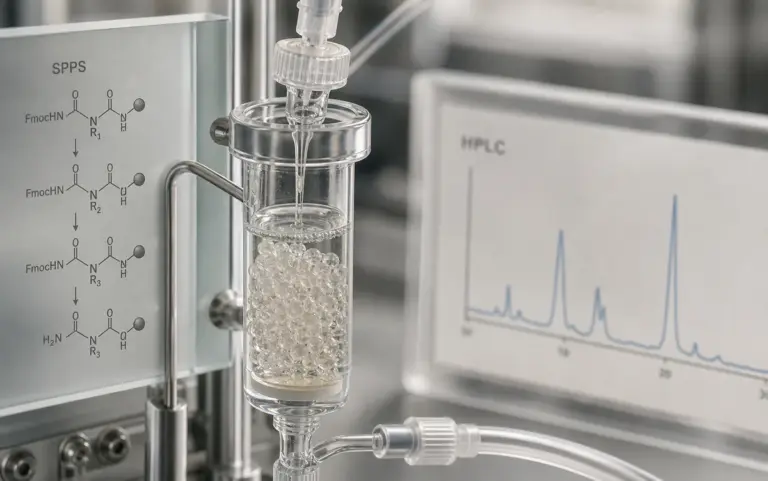
Solid-Phase Peptide Synthesis: How Research-Grade Peptides Are Actually Made
Solid-phase peptide synthesis is the chemistry behind every research peptide in the modern catalog: how the process works, why it governs purity, and how…
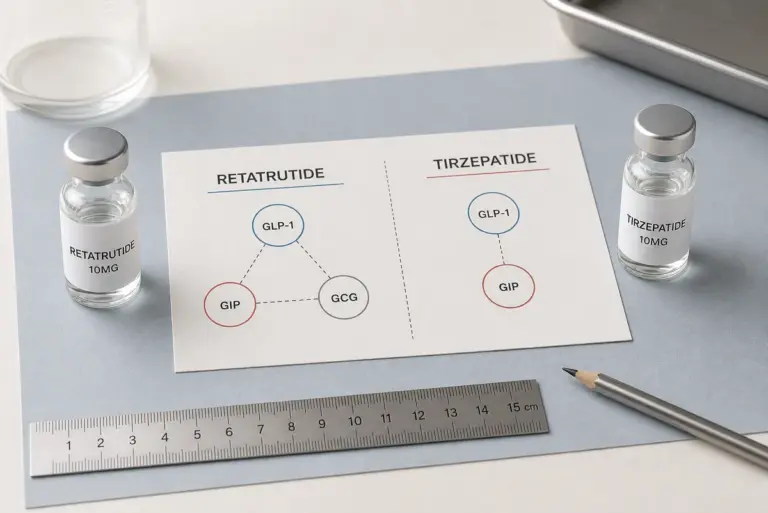
Retatrutide vs Tirzepatide: Triple-Agonist vs Dual-Agonist Mechanism
Both are incretin-mimetic research peptides, but they engage categorically different receptor combinations. The mechanism distinction is what determines which one suits a given protocol.