
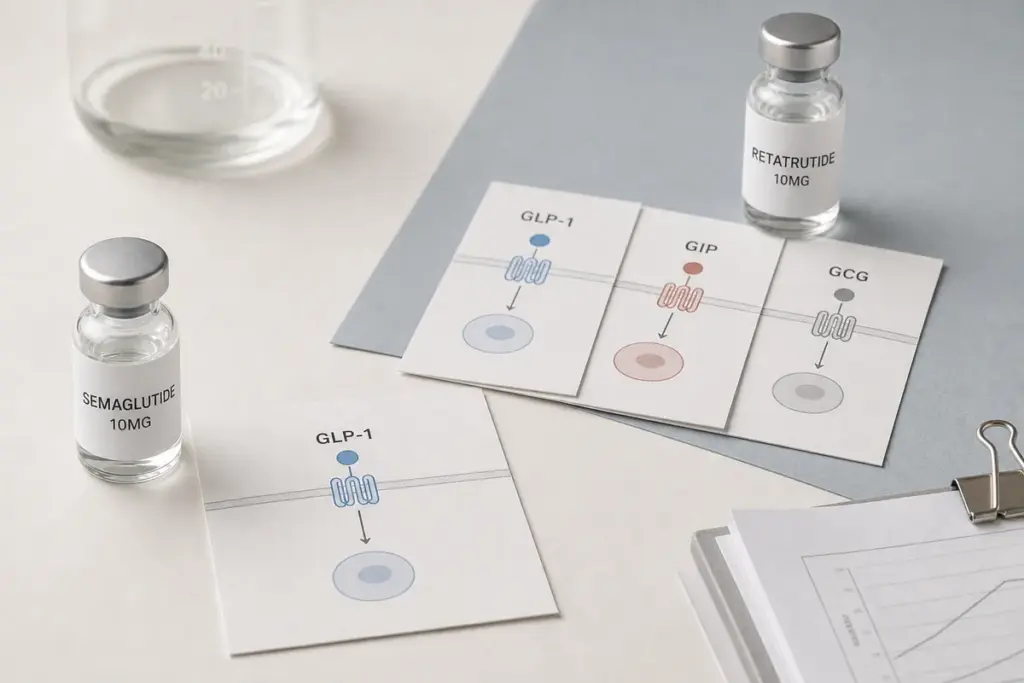
Semaglutide and Retatrutide both turn up in modern incretin-mimetic research, but they mark opposite ends of the receptor-engagement spectrum. Semaglutide activates one receptor, cleanly. Retatrutide activates three. They belong to the same conceptual family, and as research instruments they could hardly be more different.
The gap matters because the number of receptors a molecule engages, not its raw potency, is what shapes the downstream signature. One pathway and three pathways answer different questions. Reading one compound's data as if it stood in for the other is where a lot of confusion starts.
Semaglutide: the single-pathway reference
Semaglutide is the most-cited GLP-1 receptor agonist in metabolic research, and its value is its narrow specificity. It activates GLP-1R and nothing adjacent. GLP-1 itself is a pleiotropic incretin hormone: a 2019 review in Molecular Metabolism sets out its core actions, which include glucose-dependent insulin secretion, appetite suppression, and slowed gastric emptying.
The molecule is an engineered version of native GLP-1. The 2015 paper describing its discovery details the fatty-acid acylation that lets it bind albumin and stay in circulation far longer than the native hormone, which is what made once-weekly schedules possible in the clinic. For research purposes the relevant point is simpler: semaglutide is a clean, long-acting GLP-1R agonist.
That cleanliness is exactly why it works as a control compound. When a study needs a known single-pathway reference to compare a dual or triple agonist against, semaglutide has the deepest published literature to anchor it.
Retatrutide: three pathways, one molecule
Retatrutide is a synthetic peptide built to activate GLP-1R, GIPR, and the glucagon receptor at once. The 2022 Cell Metabolism paper that introduced it reported that the glucagon-receptor arm drove increased energy expenditure in obese-mouse models, while the GIP and GLP-1 arms reduced caloric intake. The receptor balance was tuned during design so the glucagon arm adds energy expenditure and lipolysis without destabilising glucose handling.
In the literature, Retatrutide is the canonical triple-agonist instrument. Studies focused on hepatic glucose output, lipid-handling endpoints, or combined metabolic-stress modeling reference it directly, because the third receptor opens up questions a single-pathway agonist cannot reach.
Same family, different instruments
It is tempting to read the shared GLP-1 arm as a shared identity. It is not. Semaglutide is the GLP-1 arm and nothing else. In Retatrutide, the GLP-1 arm is one of three voices in a tuned chord, and what the molecule does with that receptor is constrained by what else it engages at the same time. That is why the triple agonist's behaviour cannot be predicted by scaling up the single agonist's.
Choosing between them
The decision is not which is more powerful. It is which receptor profile matches the hypothesis. A study isolating GLP-1R-specific kinetics needs Semaglutide. A study mapping what GIP and glucagon engagement add on top needs Retatrutide. Running both side by side is the standard design for quantifying the contribution of each additional receptor arm.
Using one to answer the other's question dilutes the signal. The receptor count is the experimental variable, and these two compounds sit at the far ends of it.
Operational notes
Both ship lyophilized in 10mg vials and reconstitute in standard bacteriostatic water for injection. Janoshik third-party HPLC verification applies per-lot. For a head-to-head single-versus-triple design, pair lots from the same synthesis window so lot variance does not contaminate the receptor comparison.
This article describes mechanisms and applications studied in research models. NZM peptides are sold strictly for in vitro and animal research. They are not for human consumption, off-label use, or clinical application.
From the desk.

Wegovy vs Ozempic: Same Compound, Different Brand Identity
Wegovy and Ozempic share the same active molecule (semaglutide). They are distinct branded products with different indications and dose strengths, but the mechanism is…
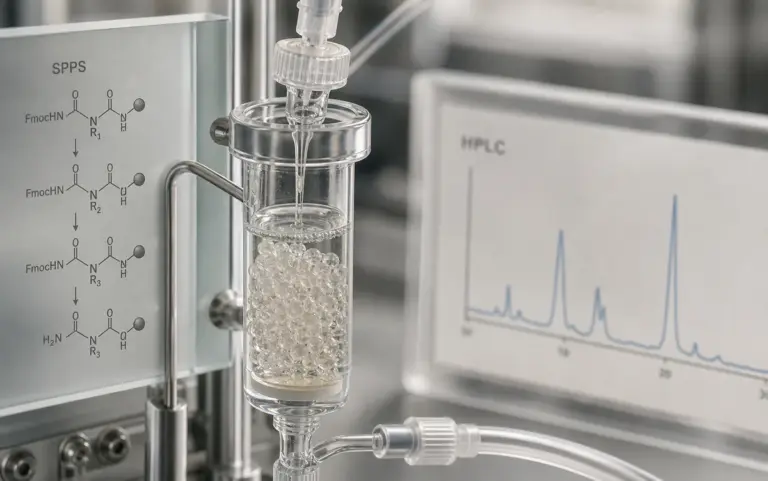
Solid-Phase Peptide Synthesis: How Research-Grade Peptides Are Actually Made
Solid-phase peptide synthesis is the chemistry behind every research peptide in the modern catalog: how the process works, why it governs purity, and how…
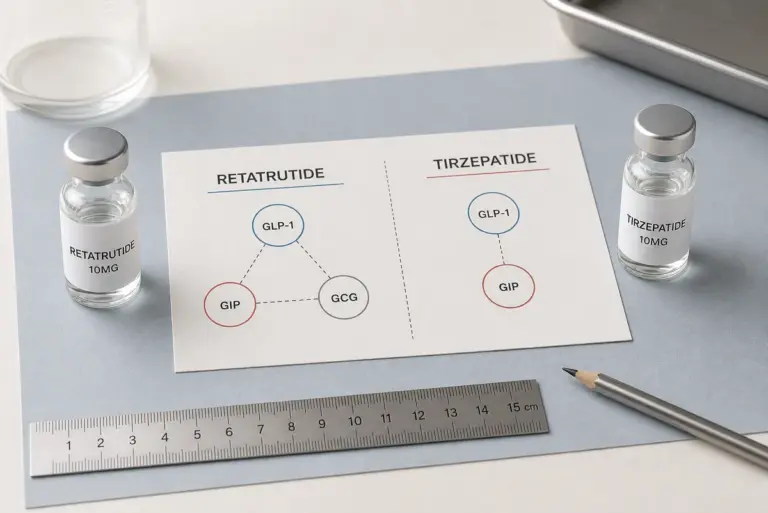
Retatrutide vs Tirzepatide: Triple-Agonist vs Dual-Agonist Mechanism
Both are incretin-mimetic research peptides, but they engage categorically different receptor combinations. The mechanism distinction is what determines which one suits a given protocol.