
Retatrutide vs Ozempic: Research Compound vs Branded GLP-1
Ozempic is the branded prescription form of semaglutide. Retatrutide is a research-grade triple-agonist peptide. The names sit in different worlds, and the comparison researchers are usually asking is mechanism, not vendor.

When researchers search 'retatrutide vs ozempic' they are usually asking a mechanism question, not a procurement one. Ozempic is a branded prescription product, and its active compound is semaglutide. Retatrutide is a separate molecule, a research-grade triple-agonist peptide. The comparison that means anything is between their receptor profiles, not their labels.
This article stays on mechanism. It is not a clinical or treatment comparison, and nothing here translates into consumer-product guidance or substitution advice. The two are not alternatives to each other. They are different points on a receptor-engagement axis.
Ozempic is semaglutide, a single-pathway GLP-1 agonist
The active ingredient in Ozempic is semaglutide. The FDA prescribing information describes it plainly as a human GLP-1 receptor agonist. Activating GLP-1R engages the glycemic and satiety pathways, and the receptor profile is narrow by design.
Semaglutide is an engineered GLP-1 analog. The 2015 discovery paper describes the fatty-acid acylation that binds it to albumin and extends its half-life. Ozempic and semaglutide are the same molecule under different identifiers: Ozempic is the trade-name presentation, semaglutide is the chemical entity. Research uses the chemical entity.
Retatrutide engages three receptors
Retatrutide activates GLP-1R, GIPR, and the glucagon receptor. It shares the GLP-1 arm with semaglutide and adds two more. The 2022 Cell Metabolism paper that introduced it reported that the glucagon arm drove increased energy expenditure in research models, while the GIP and GLP-1 arms reduced caloric intake. That extra engagement broadens the metabolic response well past what a single-pathway GLP-1 agonist produces.
Studies that compare single-pathway against triple-pathway engagement use both as reference points: semaglutide (the molecule in Ozempic) as the GLP-1 baseline, Retatrutide as the triple-agonist instrument. The comparison is a decomposition, not a ranking.
The shared GLP-1 arm
The one thing the two molecules genuinely share is the GLP-1 receptor arm. In Ozempic's semaglutide, that arm is the whole mechanism. In Retatrutide, it is one input among three, and its behaviour is shaped by the GIP and glucagon arms working alongside it. The receptor is identical; what the molecule does with it is not, and that is the distinction the search term usually misses.
Why the comparison matters in research
Side by side, the two molecules let a study quantify how much of an incretin-mimetic response comes from GLP-1R alone versus from combined GLP-1, GIP, and glucagon engagement. That decomposition is what a triple-versus-single design is built to measure.
They are calibration points, not substitutes. Choosing one over the other is choosing which mechanism question to answer, which is a different decision from anything a consumer-product comparison would be asking.
Operational notes
Research-grade retatrutide ships lyophilized in 10mg vials and reconstitutes in standard bacteriostatic water for injection, with per-lot Janoshik HPLC verification. The branded prescription product is a formulated drug on a different supply chain entirely. For a receptor-profile study, the research-grade chemical entity is what the design actually needs.
This article describes mechanisms and applications studied in research models. NZM peptides are sold strictly for in vitro and animal research. They are not for human consumption, off-label use, or clinical application.
From the desk.

Wegovy vs Ozempic: Same Compound, Different Brand Identity
Wegovy and Ozempic share the same active molecule (semaglutide). They are distinct branded products with different indications and dose strengths, but the mechanism is…

Solid-Phase Peptide Synthesis: How Research-Grade Peptides Are Actually Made
Solid-phase peptide synthesis is the chemistry behind every research peptide in the modern catalog: how the process works, why it governs purity, and how…
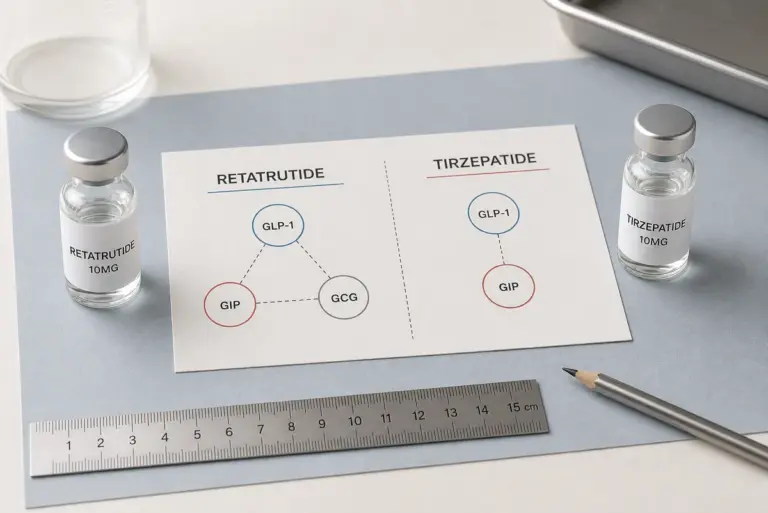
Retatrutide vs Tirzepatide: Triple-Agonist vs Dual-Agonist Mechanism
Both are incretin-mimetic research peptides, but they engage categorically different receptor combinations. The mechanism distinction is what determines which one suits a given protocol.